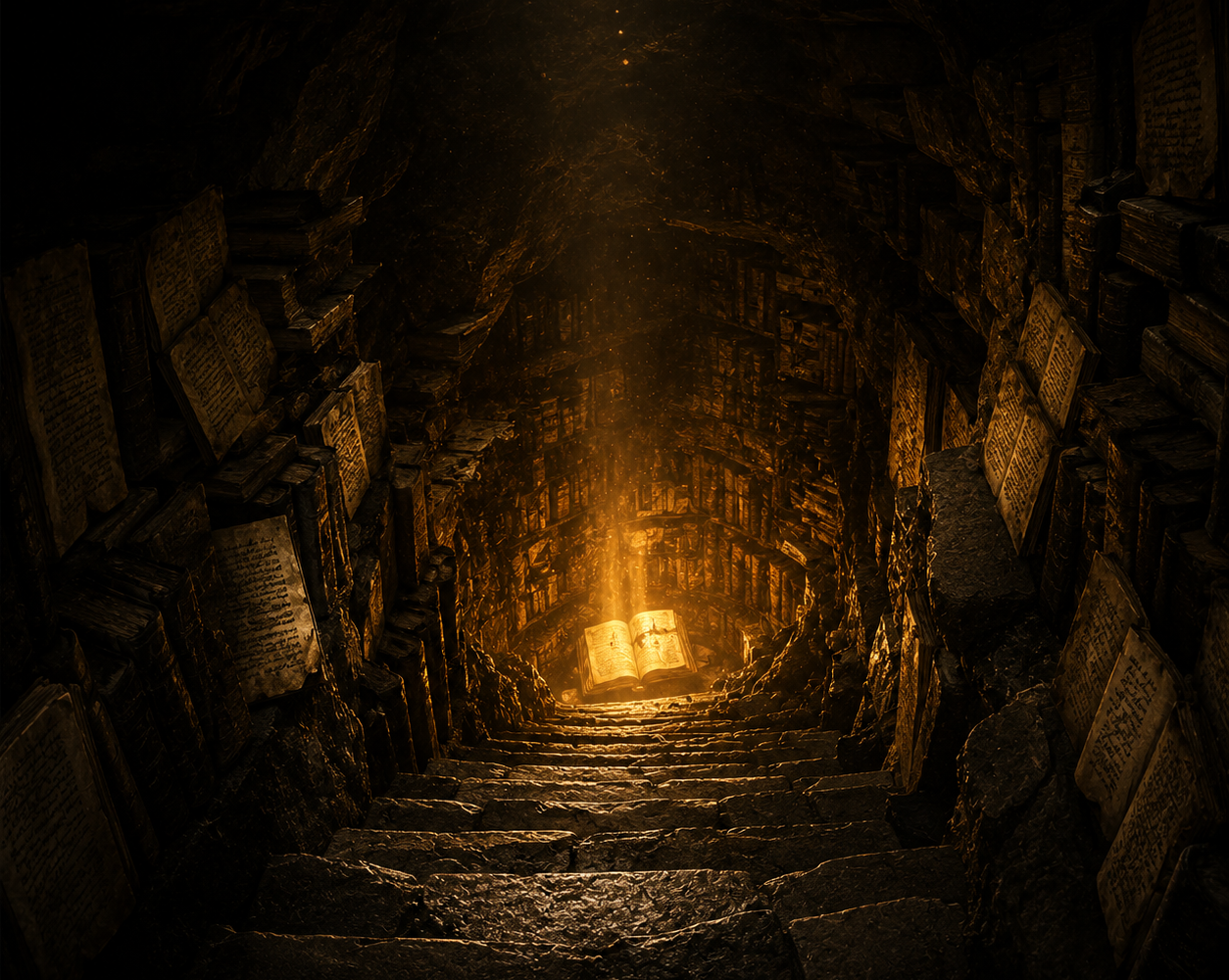
There is a brutal difference between receiving information and seeking understanding.
Receiving is passive. The feed delivers, the algorithm chooses, the video starts on its own, and the person feels they are learning because they are constantly being informed. But information received without effort has the same depth as the attention that received it: almost none.
Seeking is something else. Seeking has a verb, a direction, and sweat.
Proverbs 2 describes the acquisition of wisdom with a sequence of verbs that leaves no doubt: accept, store up, turn your ear, apply your heart, call out, lift your voice, seek like silver, search as for hidden treasure.
None of those verbs describes someone scrolling a screen.
All of them describe someone digging.
The feed delivers surface. The treasure lies beneath it.
Our era has created a new illusion: the sensation of learning without the substance of it.
A person watches three videos on a topic and feels they understand it. Saves twenty posts and feels they have studied. Listens to a book summary and feels they have read. Consumption produces the sensation, but it does not produce the structure. And the difference appears at the first real test: when it is necessary to decide, explain, apply or defend that knowledge under pressure.
That is when the surface cracks.
Proverbs 2 says that what is valuable lies hidden, like silver, like treasure. And hidden treasure has an uncomfortable characteristic: the first layers of excavation deliver nothing. It is dirt, rock, effort without visible reward. Most people give up exactly there, return to the surface, and call it “time optimisation”.
Whoever keeps digging crosses the layer of discomfort and arrives where few people arrive: at the understanding that bears weight.
Digging is a method, not a talent
The good news is that intellectual excavation is not a gift. It is a practice. And it has clear components:
Choosing where to dig. Nobody digs in twenty places at once. Depth requires the courage to choose a few topics and accept being temporarily shallow in the rest.
Returning to the same spot. Rereading the difficult chapter. Redoing the exercise. Revisiting the note. Repetition is not delay; it is the spade striking the same point until the layer breaks.
Asking real questions. Whoever seeks, in the vocabulary of Proverbs, calls out and lifts their voice. Applied to study: ask those who know more, expose your own ignorance, prefer correction to comfort.
Applying before accumulating. Knowledge that never becomes practice becomes stock. And mental stock, unlike treasure, deteriorates.
Enduring the discomfort. Every depth has a layer where the subject becomes difficult, confusing and utterly unrewarding. That layer is not a sign that you are not made for the topic. It is a sign that you have reached the point where most people quit.
What Proverbs 2 teaches about learning in practice
1. Understanding is asked for and dug for
Calling out for insight and seeking it like silver: an active posture, never passive reception.
2. What is hidden is worth more than what is exposed
What everyone knows differentiates no one. The value sits in the layers that demand effort.
3. Keeping matters as much as finding
The text speaks of storing up commands within you. Learning without retaining and applying is digging and leaving the treasure in the hole.
4. The search shapes the seeker
Whoever digs deeply into one topic does not only gain the topic. They gain the ability to dig into any topic.
5. Deep understanding becomes protection
Discretion guards. A mind that truly understands is not led by the first convincing narrative.
From zero to black belt: how to leave consumption and enter excavation
Level 0 — Recognise the difference
Consumption produces the sensation of learning. Excavation produces structure. Be honest about which of the two you live in.
Level 1 — Choose the ground
- define two or three topics that deserve depth in your life right now
- accept being shallow in the rest, without guilt
Level 2 — Abandon the surface habits
- collecting content without processing it
- trading depth for infinite variety
- studying only what confirms what you already think
- quitting at the first difficult layer
Level 3 — Install the excavation method
- study with a notebook, not just a screen
- reread, summarise in your own words, teach someone
- seek out better people and ask real questions
- apply it to something real within days, not months
Level 4 — Mature reading
- build your own criteria from the foundations you dug
- connect depths: the mastered topic illuminates its neighbours
- turn the ability to learn into your most durable asset
What I think about this
What I think is direct: surface is free, depth has a price, and that is exactly why it is worth it.
If deep understanding were comfortable, it would differentiate no one. The effort barrier is what keeps the treasure hidden, and it is also what guarantees the value of whoever unearths it.
In my view, the most valuable skill of the next decade is not any specific knowledge. It is the ability to dig: to take an unknown topic, cross the discomfort of the first layers, and reach an understanding that can sustain a decision. Whoever has that adapts to any change. Whoever only consumes remains hostage to whatever the algorithm decides to deliver.
The mind that seeks finds. The mind that only receives depends.
What my journey has taught me so far
I learned, in practice, that my biggest leaps came from seasons of excavation into a single topic, not from periods when I consumed a little of everything.
I also learned to respect the discomfort layer. Today, when a subject becomes confusing and thankless, I read that as a sign of progress, not incapacity. It is the ground getting harder because the treasure is getting closer.
And I learned that teaching is the most efficient spade there is. When I have to explain something to someone, I discover within minutes what I truly understood and what I had merely consumed.
Where I see the biggest traps
- confusing screen time with study time
- accumulating courses like accumulating intentions
- reading the summary and believing you read the work
- studying to post, not to understand
- changing topics whenever the difficult layer arrives
- outsourcing your thinking to whoever speaks with the most confidence
Where I see the biggest opportunities
- real depth in a shallow world becomes authority quickly
- whoever knows how to dig can learn anything the future demands
- deep understanding generates criteria, and criteria generate good decisions in series
- the discipline of study overflows into every other area of life
Conclusion
Proverbs 2 does not describe a passive student. It describes a miner.
Whoever only receives information lives off whatever surface is handed to them. Whoever digs for understanding builds their own structure. Whoever builds structure develops criteria. Whoever has criteria is not led by just any narrative.
In learning, that is decisive.
Because the mind is not shaped by what passes through it. It is shaped by what it decides to excavate, keep and apply.
In the end, the question is not how much content you consume per day. The more serious question is:
when was the last time you dug into a topic down to the depth where most people give up?
Surface knowledge feeds the conversation; excavated knowledge sustains life.
Follow the Proverbs in Practice series at juniorgaino.com. Tomorrow we go to the heart of Proverbs 2: the Lord as the source of wisdom, and why seeking God is worth more than seeking answers alone.